Umwelt - 'animal sense worlds'
Umwelt
Umwelt is a German word that translates to "environment" or "surroundings" but was used by Jakob Johann von Uexküll, a Baltic Scientist writing at the turn of last century to mean the unique ‘sense worlds’ of animal species, including our own. I came across it in a remarkable book by Ed Yong called An Immense World which is what prompted me to fall down this bilby hole.
Human Senses
Human’s have supposedly 5 senses. Though it is argued that we also have the sense of ‘proprioception’, the awareness of your own body, and ‘equilibrioception’, the sense of balance, linked to both sight and touch. And ‘temperature’, ‘nociception’ (the sensory nervous system's process of detecting and encoding actual or potential tissue-damaging stimuli. It serves as an essential biological warning system that identifies mechanical, thermal, or chemical threats and triggers defensive reflexes) and ‘motion’. And there is some studies that have argued that we have a sense of the earth's magnetic field.
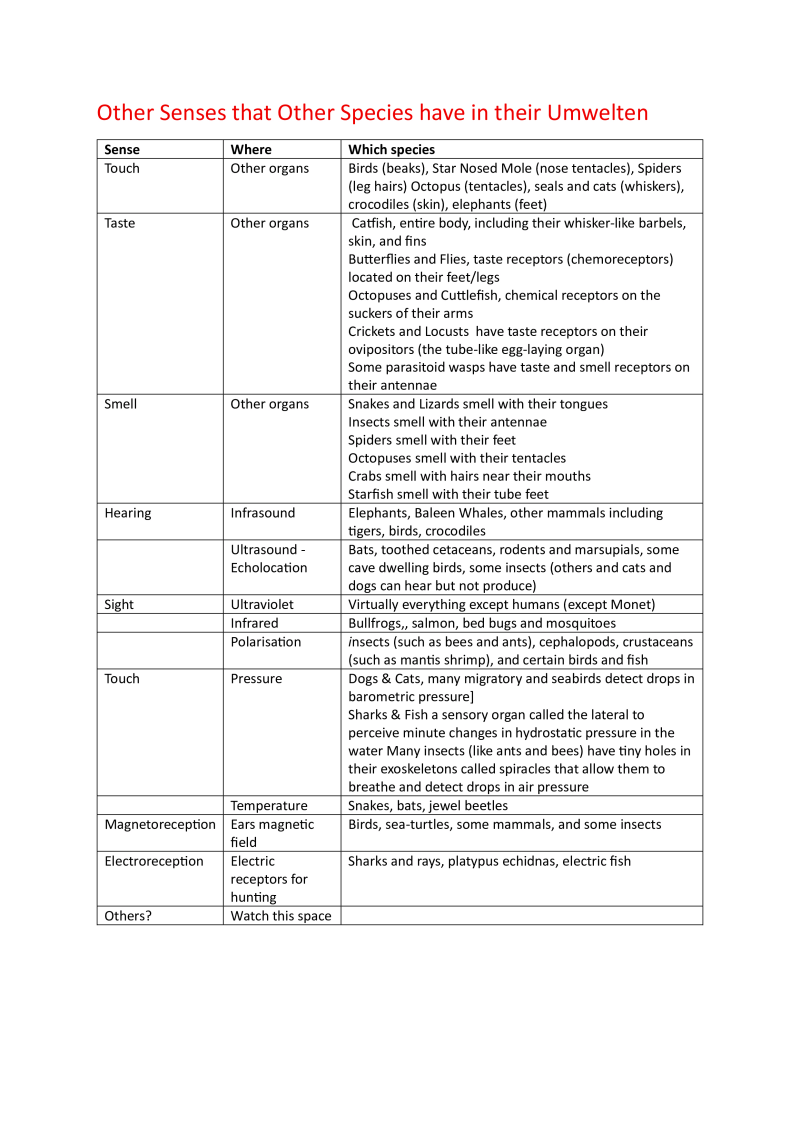
Other animals may share variations some of our top 5, or may have others that we don’t have such as seeing ultra-violet, or hearing infrasound.
It is important to realise that most human body parts are shared with species we evolved from some time in the past and that we are not so different from those that also evolved.
Vision
Most humans have three colour cones in our eyes. RGB (and heavy on the G). Our brains make up the rest of the colours [slide of three colour diagram]. Birds, some fish and some women (as it’s attached to the X chromosome) have 4 colour cones, allowing them to see thousands more colours, including ultraviolet, which we can’t.
If you think of our colour spectrum as a triangle with three axis, then theirs is a pyramid, with four axes and colours like rurple, grurple, yurple and ultrapurple Yong’s name for UV Red, UV Green, UV Yellow and UV purple. [slides]
And there is a Mantis Shrimp [slide] which has 12 colour cones, and can see 3 sorts of polarised light. It is very colourful itself and supposedly packs the hardest punch on the planet, vaporising water.
Although I read recently that cnidarians (includes sea anemones) possess a microscopic stinging organ called a nematocyst that acts like a biological bullet. It is one of the fastest and most highly accelerated mechanical processes in nature firing in less than 700 nanoseconds at 5 million Gs, roughly 50 times faster than a standard rifle bullet.
But I digress. What we see is not the physics of light, not detecting wave lengths of colour but comparing them. It is what our brains make of that light, a function called opponency. It is how we make yellow and other colours.
[show umwelt apps]
Returning to birds, they, and many species of reptiles, fish, insects, and mammals can see UV. Some humans, including Monet, but we are the exception, at the cost of having sharp eyesight.
Most avian plumage colors are the result of different types of pigments that are deposited into feathers while they are regrowing after moult. Blues and white typically result from small changes in feather structure that alters their light reflective properties. These fundamental modifications cause violet and blue light to be selectively reflected from the feather surface in the case of violet/blue feathers, while white feathers reflect all visible light. Violets, blues and whites are structural colours, or schemochromes.
Because our vision is limited to three cones we fail to see how beautiful the world of nature is.
In the evolutionary world, some flowers use dramatic UV patters to attract pollinators like birds and bees. Birds’ feathers reflect a lot of UV, and this can differentiate the genders. Fish too, have striking UV patterns that are visible to potential mates but invisible to predators. What we see in a raven as black, is actually a shimmering of colours.
[UV camera demonstration]
Different species have different degrees of vision, in terms of their field of view. Because humans have their eyes in the front of the face they have good forward vision 180 degrees, but only peripheral vision and must turn to see things. Owls have 110 degrees of forward vision can swivel their heads to give them 270 degrees. Owls have acute hearing and because their ears are asymmetrical they can hear and pinpoint sound from 360 degrees around, better than human symmetrical ears.
Eagles have an impressive 340-degree field of view. Because their eyes are angled about 30 degrees from the midline of the face, they can see in almost all directions simultaneously, but have a small blind spot in front of their beak. And they have 20/5 vision, and visual acuity that can see rabbits at 3km. Vultures rely on two front-facing eyes for a wide, overlapping binocular field, a vulture's binocular vision is quite narrow—typically 20 to 30 degrees depending on the species, and they have large blind spots, and are often victims of wind towers.
[eagle glasses, window, demonstrate]
Fly Eyes
A lot of insects and crustaceans have compound eyes, where the eye that is made up of many smaller visual units. Each unit is called an ommatidium. A single ommatidium works sort of like a single human eye, collecting and processing incoming light. This allows the ommatidium to capture one small view of the world. All those small views from a compound eye combine like the pixels of an image to create one larger view. They’re the oldest known eye, and evolved about 500 million years ago.
Different species have different numbers of ommatidia per eye. Some ants have only a few. Meanwhile, some dragonflies have tens of thousands. The more units a compound eye contains, the sharper an image it creates. But even tens of thousands of ommatidia, or pixels, per eye is not very many. The resolution of human vision is estimated to be millions of pixels.
Compound eyes are not known for their sharp vision. But they do offer animals very wide fields of view. And they are generally quite good at detecting movement.
[glasses, Isadora, demonstration]
Snakes
Snakes have the five human senses. Most snakes have three visual pigments, two of which are in cones, making them dichromatic in daylight. Most snakes are sensitive to UV light, which allows them to see well in low light conditions. For light to reach the retina and be absorbed by the pigments, it first travels through the lens of the eye. Snakes with UV-sensitive visual pigments therefore have lenses that let UV light though. In contrast, snakes that rely on very sharp eyesight in the daytime have lenses that block UV light.
In addition, some snakes also have thermal pits. Boas, pythons, pit vipers and rattlesnakes can detect the heat of their prey. Some believe that they are a modified pair of eyes that can see infrared, though with les clarity than eyes. And their pits work in unison with their eyes. However, their tongues are forked which is thought gives them directionality.
There is still much known about this sense, including why it evolved. Snakes don’t need to eat often and can spend long periods waiting for prey. And they remodel their intestines while they digest, swelling their heart, stomach and liver.
[thermal cameras demonstration]
Electricity
Like us, where we use 5 (arguably more) in navigating the world, other species also mostly use a combination of senses.
Takes sharks. When I was writing about this last year in Newcastle, I came across the figure that there were only 10 shark related deaths in the world annually. There were two just to the north that week, and we have just had 2 in WA and an incident at Coogee. We might want to look at the big picture of why that is happening.
But sharks have an amazing sense of smell. It is said they can smell a drop of blood in a swimming pool. They only see in monochrome, but quite well. Apparently, they have a blind spot right in front of them and one behind, and they have a transition period in at dawn and dusk where their eyes adjust to light or dark, and this is the time they are most dangerous. They have’ like many fish, a lateral line that senses disturbance in water. And they have electrical receptors called the Ampullae of Lorenzini that detect the electric currents generated by other animals. When hunting, they use vision, and smell, and as they home in the water movement and then electrical fields. It is also conjectured that they have an electromagnetic sense for long distance navigation.
[shark puppet demonstration]
There are fish that live in darkness, and create electric fields around themselves which is how they get most their sensory inputs.
Sound
Humans can detect sounds in a frequency range from about 20 Hz to 20 kHz. Not me, I cut out about 5kHz. More like a bird that ranges from 1000hz to 4000kHz. Mice and rats can hear up to 40kHz.
[app demonstration] Put your hand up when you can hear it – go up. Then down when you can’t.
Most animals have a hearing range similar to humans. many animals can "hear" through their feet, antennae, and skin by detecting vibrations and pressure waves. We do as well, hence the emergence of bone conducting headphones and why your spoken voice sounds slightly different to your recorded voice.
Some animals can hear Infrasound, elephants, rhinos, hippopotamus and baleen whale. And then some can hear Ultrasound, bats, cats and dogs, and toothed cetaceans, the Odontoceti (dolphins, orcas, and sperm whales). Ultrasound was only confirmed in the late 1930s and infrasound in the 1960s Katy Payne only confirmed elephants using it in the 1980s.
With the exception of pets, many of these animals use echolocation to navigate space. The sperm whales lips (monkey lips) are at the front of its skull and the sound travels backwards and then bounces forwards in a beam only 4 degrees wide. At 236 decibels it is the loudest sound an animal can make.
Project Ceti, using new recording technologies, free divers and AI is making great advances in deciphering their language.
Bats too use ultrasonic sound to navigate in darkness. And again loud. Jet engine loud at 138 decibels. They have a little muscular trick where they block their ears when calling and open them microseconds later when the echo returns.
[sonar demonstration]
Magnetoreception
Some animals have the biological ability to detect the Earth’s magnetic field for orientation and navigation and this is found across a wide variety of species, including birds, reptiles and amphibians, sea creatures, insects, and mammals.
Animals known to have magnetoreceptors include : Migratory birds like the Arctic Tern and homing pigeons use a quantum chemical reaction in their eyes (relying on a protein called cryptochrome) and magnetic particles in their tissues to navigate. Sea turtles, salmon, whales, and spiny lobsters use magnetic fields to traverse oceans and find specific feeding or breeding grounds. Bats, mice, mole rats, and even domestic dogs and some primates possess magnetic receptors, often linked to light-sensitive proteins in their eyes. A study of 37 dog species in German showed they all poo in a north-south direction. Humans also seem to feel the magnetic field. Honeybees, ants, and fruit flies use magnetoreception to locate food sources and navigate back to their nests.
There are also magnetotactic bacteria (MTB) which produce internal nanoparticles of magnetite (or greigite (an iron sulfide mineral). Bout time I had a rock named after me. According to the symbiotic magnetic-sensing hypothesis, these bacteria may live inside the specialized sensory organs—such as the inner ears, eyes, or noses—of certain animals to give them their magnetic.
Pressure
I mentioned this above with sharks, but a lot of fish have lateral lines, that detect faint pressure changes. There are two types of neuromasts in their skins that can detect incredibly faint hydrodynamic stimuli. Some species can sense water currents as weak as 0.03 millimetres per second, and surface-feeding fish can detect water surface waves caused by displacements as tiny as 0.0007 micrometres. This, and vision, explain how fish school so perfectly.
Critical Flicker-Fusion frequency,
The two other things I want to talk quickly about are animals CFFFs, Critical Flicker-Fusion frequency, a measure of how quickly a brain can process visual information, like a frame rate. For humans in good light is about 60Hz. Generally it pertains to the animal’s size. Cats are slower at 48Hz so our movement appears choppy, dogs faster at 75Hz so we look in slo mo to them. Scallops 1 to 5Hz, and bees, dragon flies, and flys between 200Hz and 350Hz. Pied Flycatchers (and probably willy-wagtails are 146Hz.
Exafferance and Reafference.
And then there’s exafferance and reafference. The former is sensory feedback caused by the outside world, and the latter the sensory feedback generated by your own self-initiated movements (e.g., the visual shift that happens when you turn your head). Every animal has had to work out a way of distinguishing the two. But the signals are the same from the point of view of the sense organ.
And I’ll quote directly from Ed here. “The problem is so fundamental are very different creatures have solved it in this in the same way when an animal decides to move its nervous system issues a motor command a set of neural signals that tell its muscles what to do but on the way to the muscles this command is duplicated the copy heads to the sensory system which uses it to simplify simulate the consequences of the intended movement when the movement actually occurs the sensors have already predicted the self-produced signals tattered layabout to experience and by comparing the that prediction against reality they can work out which signals are actually coming from the outside world and react to them appropriately all this happens unconsciously and while it isn't intuitive it is central to our experience of the world the information to protected by the census is always a mix of self -produced reference and other produce X afference and animals can tell the 2 apart because their nervous systems constantly simulating the former.
Look to your left. This will send a simple signal that told some of the muscles around your eyeball to contract. How did you nervous system then use the signal to predict how the scene around you would change? We know that it did but the actual computations that occurred are still a mystery? How do you go from motor command to signal that the sensory structure can work with?
This is largely what sentence is Neuroscientist Michael Hendricks say and perhaps that's why sentience is the process of sorting perceptual experiences into self-generated and other generated.
Finish:
There is a deeper level to all this. I’ve been looking at the sense world of animals. This is how they navigate the world. There are three things every creature needs to do, find food, find a mate, and avoid predators. The 1st is tied directly to umwelt, but the second two bring the extra level of communication, how your senses allow you to communicate, which then leads to questions of cognition and sentience. And all these should inform how we treat animals.
This is just a small selection of the ways in which animals sense the world. If you’re interested in diving deeper in, I can supply you with a bibliography and list of further sources. And feel free to correspond with me
drgregpritchard@gmail.com @herofukutu
List of Objects in Bag:
Plastic with holes
Golf Ball
Swimming cap
Wooden ring
Soft cloth ball
Piece of foam
Plastic coil
Piece of coal
Bolt and screw
Some Sources:
https://oceanicresearch.org/wonders-of-the-sea/cnidarians/
https://www.nhm.ac.uk/discover/news/2016/september/study-sheds-light-on-snake-vision.html
I just found out that we humans are more sensitive to scents emitted by ripe fruits, we can sense as low as 0.0034 parts per million of isoamyl acetate, that’s the compound in a banana. That's higher than what dogs can sense!
https://bird-x.com/wp-content/uploads/Ultrasound_Whitford-Study_observations.pdf
Some bird species are apparently able to perceive ultrasound, although whether they actually “hear” it with their ears or detect it in some other way is unknown.”
https://www.theguardian.com/science/punctuated-equilibrium/2007/oct/16/birds-physics
https://pmc.ncbi.nlm.nih.gov/articles/PMC5651570/
Create Your Own Website With Webador